
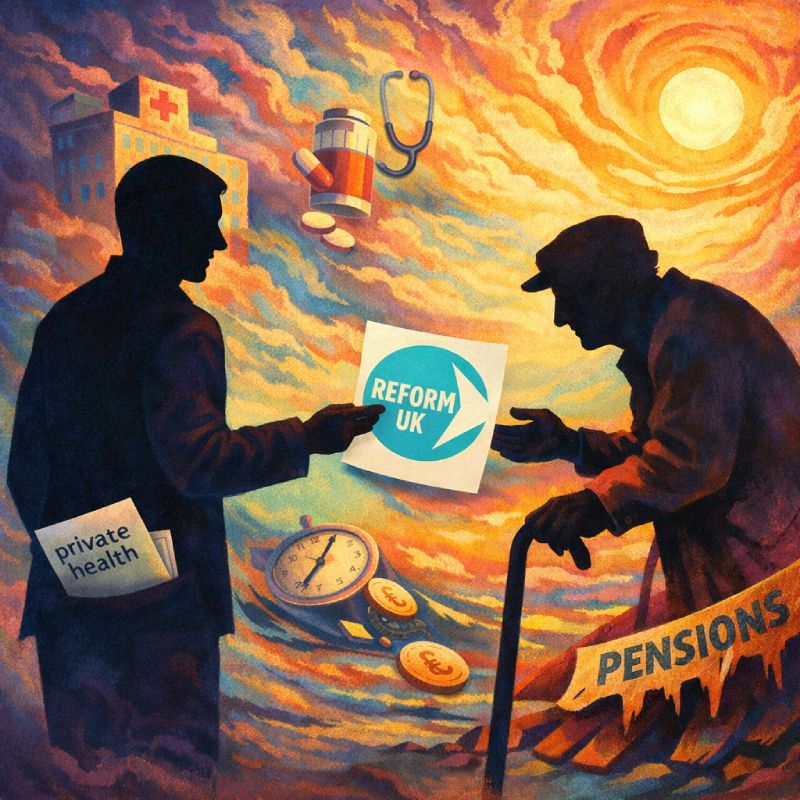
How Reform UK’s shift from tax cuts to spending cuts affects different age groups
Reform UK has quietly but significantly altered the emphasis of its economic message. During the 2024 general election campaign, the party foregrounded large and immediate tax cuts. More recently, senior figures have argued that public spending must be reduced first, with tax cuts following only once the state’s finances are stabilised. That shift raises a fundamental question: if spending cuts are prioritised, who is most likely to feel their effects?
Public spending in the UK is not evenly distributed across the population. Instead, it varies strongly by age. When spending per person is plotted against age, it follows a pronounced U-shape: high for children, lower for working-age adults, and very high for older people. This structure is not ideological but arithmetic, and it places tight constraints on what any government can realistically cut.
Children and young people account for a substantial share of public spending, largely through education and healthcare. Schooling, further education, child benefit, and early-years health services together make spending per child relatively high. However, despite this headline figure, children’s spending is not where the largest fiscal savings lie. Cuts in education or children’s services are immediately visible to families, politically sensitive, and often counterproductive in the long run. In practice, reductions tend to appear indirectly, through larger class sizes, underfunded special educational needs provision, or shrinking youth services delivered by local authorities. These measures save money at the margins but cannot close large fiscal gaps.
Working-age adults, broadly those between 19 and 64, are the least expensive age group on average. Most people in this cohort are net contributors to the public finances rather than recipients. That said, a significant minority rely heavily on state support through Universal Credit, disability benefits, housing assistance, and local authority services. Historically, this group has borne the brunt of austerity, because cuts can be framed as efficiency, reform, or incentives to work. Politically, these reductions are easier to sustain, and their effects are often dispersed and delayed.
However, the scope for further savings here is limited. The decade following 2010 already saw substantial reductions in working-age welfare and local government funding. Further cuts risk increasing poverty, worsening health outcomes, and placing additional pressure on the NHS and emergency services. While this group remains exposed, it cannot alone deliver the scale of savings required to underpin large tax reductions.
The picture changes sharply once people reach retirement age. Those aged roughly 65 to 74 receive significant public support through the State Pension, NHS care, and a range of universal benefits. This age group is also the most politically engaged, with the highest voter turnout of any cohort. From a fiscal perspective, spending here matters greatly. The State Pension is one of the largest items in the public finances, costing around £130 billion a year. Even small changes to its uprating mechanism would generate substantial savings.
Yet this is also where political resistance is strongest. Proposals to weaken the triple lock, means-test pensioner benefits, or raise the pension age provoke intense opposition. As a result, governments often talk about reform in this area while deferring action.
Spending rises further among those aged over 75, driven largely by healthcare and social care costs. NHS usage increases steeply with age, and social care, where it exists, is expensive and labour-intensive. Cuts here rarely appear as explicit budget lines. Instead, they tend to manifest as longer waiting times, tighter eligibility, and growing reliance on unpaid family carers. Apparent savings may simply shift costs to other parts of the system or to households themselves.
When the spending landscape is viewed as a whole, the largest potential savings are concentrated in a small number of areas. Slowing the growth of the State Pension would save billions, as would reducing or means-testing universal pensioner benefits. Restricting working-age welfare eligibility and cutting local government budgets also save money, but on a smaller scale. The first two options are fiscally powerful but politically dangerous; the latter two are politically easier but fiscally insufficient on their own.
This creates a fundamental tension for Reform UK. Large tax cuts require large and sustained spending reductions. Large spending reductions inevitably point towards pensions and healthcare. But pensions and healthcare are the core spending areas that service Reform’s main electoral base. How can they square this electoral reality? Or to put it another way, can Reform UK con its pensioner voters?